
Lakewood Open Records Landscape
California law starts with broad access, but the correct custodian depends on who created the file. The Lakewood City Clerk keeps records of city business. The Los Angeles County Registrar-Recorder/County Clerk, or RR/CC, holds deeds, public marriage material, voter files, and several county clerk filings. The county assessor maintains parcel and assessment data. Los Angeles Superior Court keeps case files, while state agencies hold statewide vital, license, business, and prison records.
| Lakewood record | Official keeper | Web index | Coverage and access |
|---|---|---|---|
| City business | Lakewood City Clerk | Request form, not a universal index | Online, email, phone, or City Hall request |
| Deeds and liens | LA County RR/CC | No official internet index | Records since 1850/1851; office review or copy order |
| Property and tax | LA County Assessor and Tax Collector | Address, AIN, map, and tax portals | Current data online; older rolls by request |
| Civil, probate, family, small claims | LA Superior Court | Paid party-name search | Coverage varies from 1983, 1991, or 1992; older cases at Archives |
| Vital events | LA RR/CC or CDPH-VR | No open full-record portal | Application, identity, and copy-type rules apply |
| Custody and registry | LASD, CDCR, or California DOJ | Official online lookups | Current custody or statutorily public registry data |
Openness does not erase privacy rules. Sealed and expunged cases, juvenile and adoption files, confidential marriages, protected voter addresses, Safe at Home data, military discharge records, and motor-vehicle personal information may be closed or limited. Agencies must release reasonably separable nonexempt parts after permitted redactions.
Lakewood City and County Records
The Lakewood Plan explains the split. Lakewood incorporated in 1954 and contracts for many services through Los Angeles County. City Hall therefore keeps council, ordinance, agenda, committee, planning, claims, and other municipal files, but it is not the office for most court, sheriff, deed, birth, death, or marriage records.
Use the Lakewood City Clerk request channel for city-created material. Requests may go through the online form, CityClerk@lakewoodca.gov, phone at 562-866-9771 extension 2200, or City Hall at 5050 Clark Avenue. Building-permit and code-enforcement pages exist, but research did not locate a public case database, so the City Clerk is the fallback for records not exposed through Development Services.
Lakewood also publishes an other-agency records guide. It routes sheriff and collision material to LASD, court files to Los Angeles Superior Court, and recorder, marriage, and vital material to RR/CC. That boundary saves a rejected request.
Why Lakewood Deeds Stay Offline
Deeds are public. The myth is that public means searchable on the web. Los Angeles County says it does not provide online access to real-estate records or indexes because former Government Code section 6254.21 restricts posting elected or appointed officials' home addresses without consent. Since the office cannot identify every protected address in the record set, it keeps the official index offline.
The RR/CC viewing page shows the actual access route.
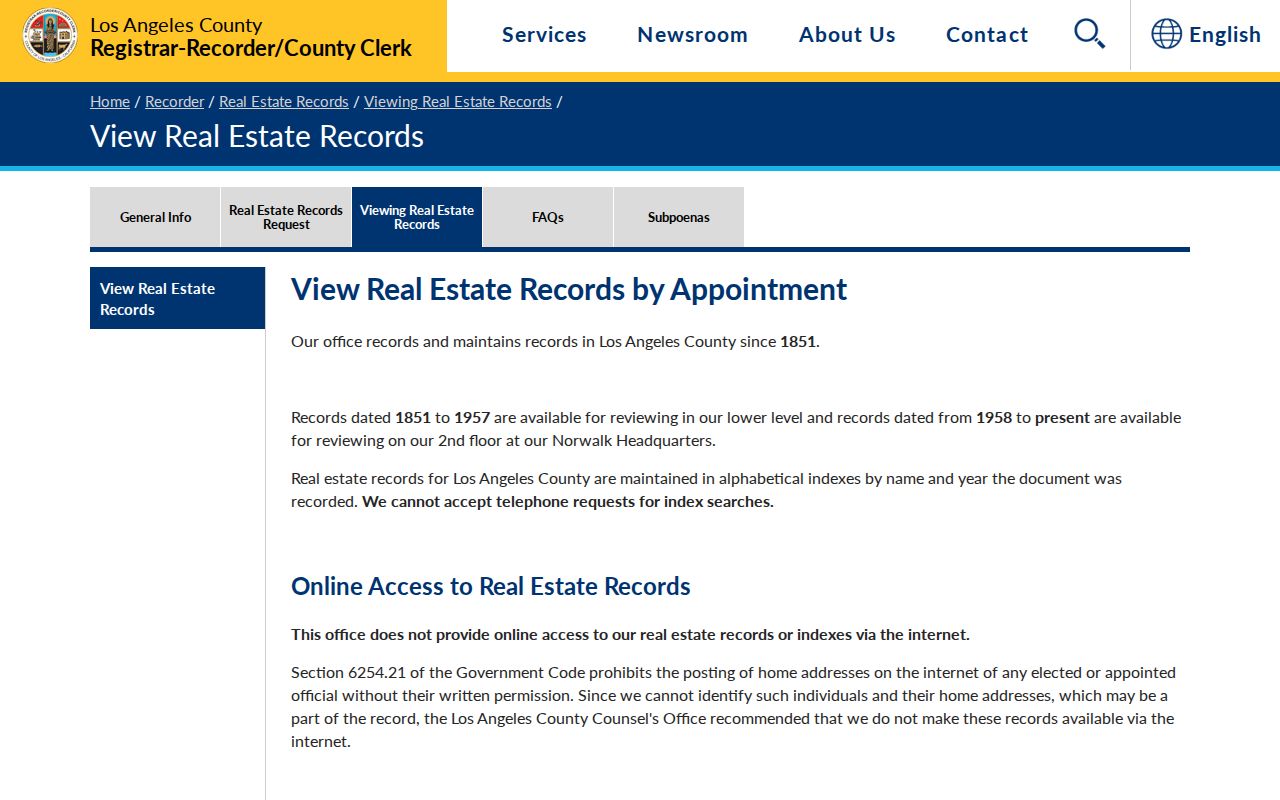
Records dated 1851 through 1957 are reviewed on the lower level at Norwalk Headquarters. Records from 1958 forward are on the second floor. The alphabetical index uses grantor or grantee name and recording year, not a street address, and appointments can be made up to two weeks ahead. RR/CC will not conduct an index search by telephone.
| Search item | How it works | Needed? |
|---|---|---|
| Grantor | The person or entity transferring an interest | One useful name key |
| Grantee | The person or entity receiving an interest | One useful name key |
| Recording year | The year RR/CC accepted the document | Needed to reach the right alphabetical index |
| Street address | Not an RR/CC index key | Start with the assessor instead |
| Approximate recording date | Helps staff locate a document for a copy order | Needed with party names when known |
Note: An index identifies a filing; an image is the document itself, and a certified copy carries the custodian's formal authentication.
Lakewood Property Records Start Online
The Los Angeles County Assessor Portal supplies the online starting point that the recorder lacks. Search by street address or AIN, the Assessor's Identification Number. The separate map search shows parcel boundaries and layers for cities, communities, ZIP codes, schools, and supervisorial districts. The county Property Tax Portal then connects assessment, bill, and payment-history services.
These sources serve different roles. The situs address is the parcel's physical location. A mailing address is where tax notices go. The legal description identifies the land in lot, block, subdivision, or other legal terms. Assessor and GIS results help confirm parcel context, but they do not replace a recorder search for the deed chain.
For a city permit or code file tied to the same address, use Lakewood Development Services first and the City Clerk request path if no public result appears. Historical assessment rolls may also require a request rather than a web search.
Lakewood Court Records by Name
Lakewood has no separate municipal court index. The Los Angeles Superior Court civil name search covers unlimited civil, probate, and family cases from 1983, limited civil from 1991, and small claims from 1992. Results can show the litigant name, case type, filing date, filing location, and number of imaged documents. Older matters go to court Archives.
A guest name search costs $4.75 regardless of the number of matches. Registered-user prices vary by search volume. Courthouse public terminals and clerk copy channels are useful when a web summary is too thin, though sealed and sensitive material remains unavailable.
The criminal defendant index searches for a case number by defendant name.
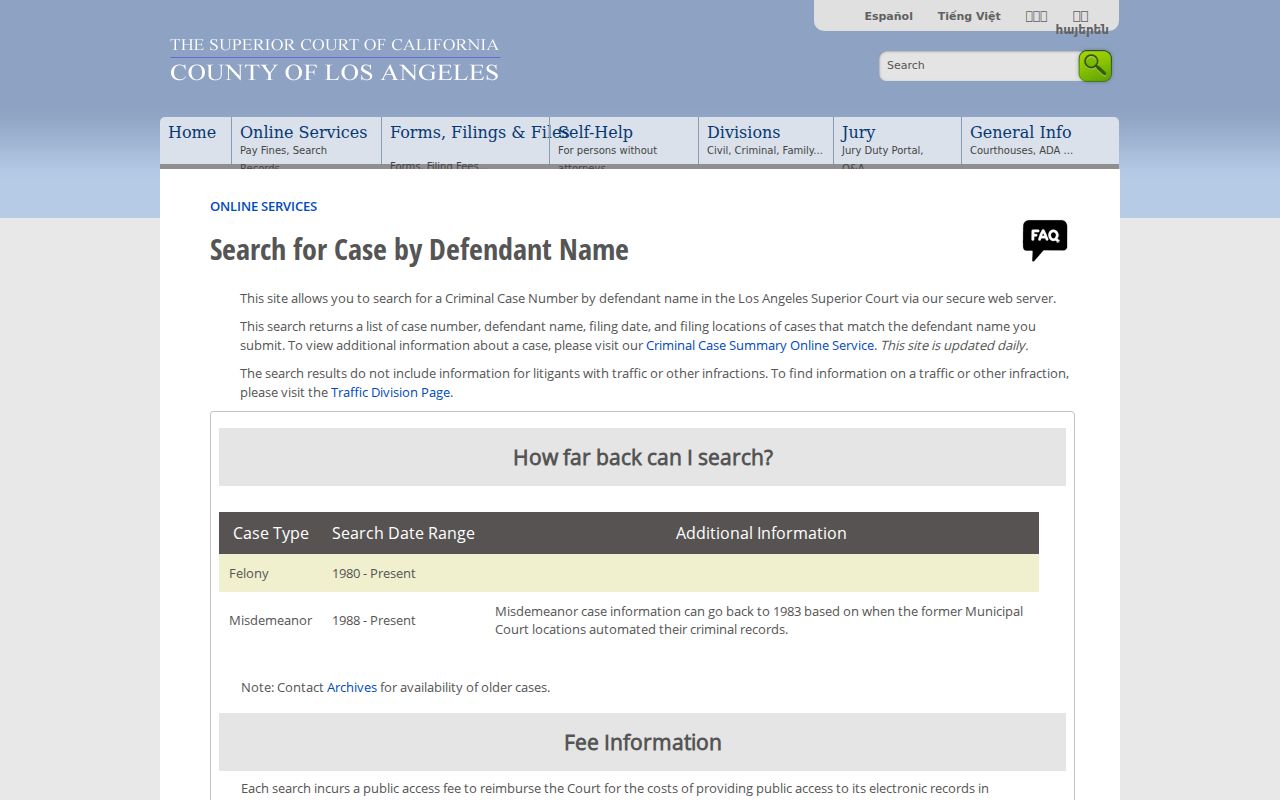
The criminal index is a court-file route, not a custody locator. Federal civil, criminal, and bankruptcy matters instead use the Central District of California clerk and PACER.
Lakewood Vital Records Copy Rules
Birth, death, and public marriage copies for Los Angeles County events come from RR/CC or the California Department of Public Health Vital Records office. Statewide CDPH records generally begin in July 1905. Earlier events may require county files, church or cemetery material, newspapers, archives, or genealogy collections.
Health and Safety Code section 103526 controls authorized certified copies. An eligible requester seeking an authorized birth, death, or marriage copy by mail must include the notarized sworn statement in the application. A person outside the authorized categories may receive an informational copy when the record is eligible, but it is marked as not valid for identity purposes. Confidential marriage records are limited to the parties or a person acting under court order and must be requested from the issuing county.
CDPH's 2026 fees are $31 for birth, $26 for death, $19 for marriage, and $18 for a dissolution certificate. Average state processing is five to seven weeks, and the county may be faster. A divorce court file remains with Los Angeles Superior Court.
Lakewood Custody and Registry Records
Lakewood contracts with the Los Angeles County Sheriff's Department, so county custody is checked through the LASD Inmate Locator. It accepts last name, with first name, middle name, and date of birth available to narrow a match.
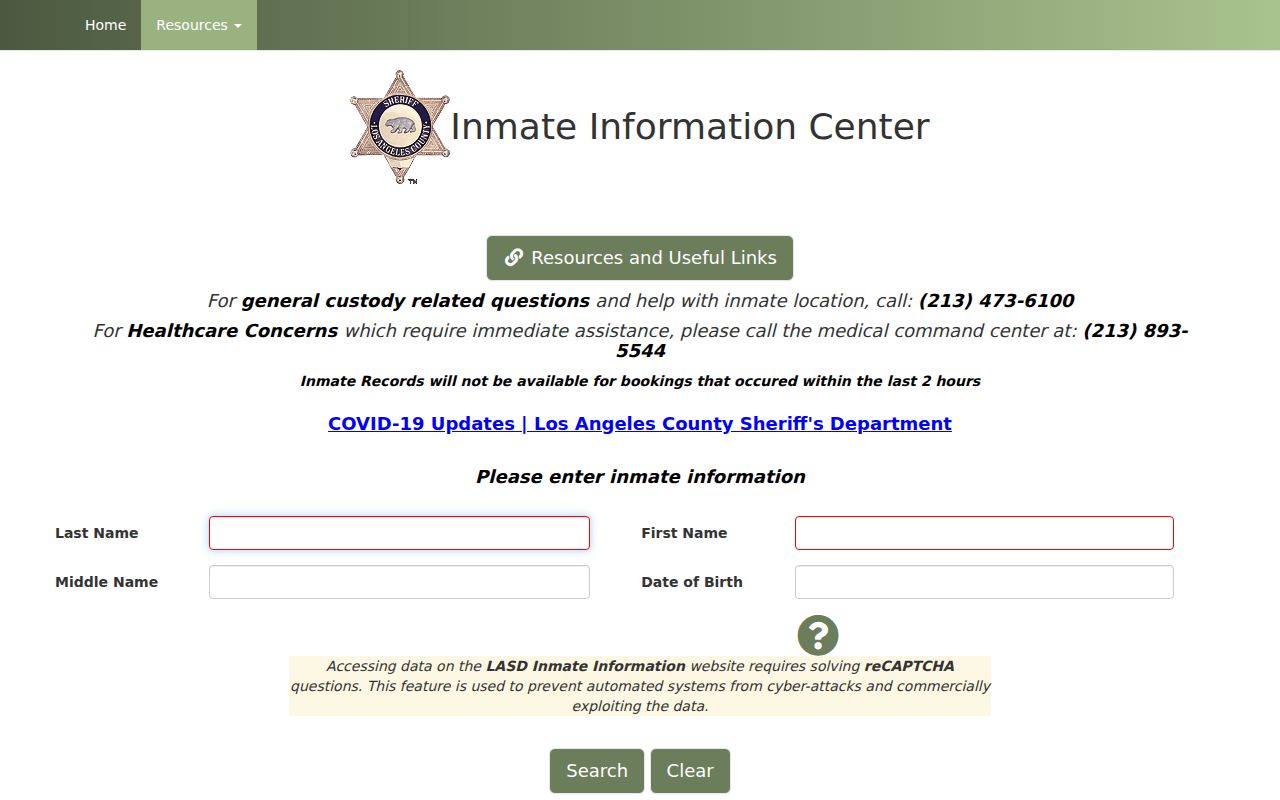
The locator concerns current county custody. It does not provide the full criminal docket or police report. Lakewood sends criminal and collision report inquiries to LASD records or 562-345-4441.
State custody is searched through California's CIRIS system, which can return a name, CDCR number, age, current location, commitment counties, admission date, and parole-hearing data for people currently in CDCR custody. The California Megan's Law site is a separate public-safety registry under Penal Code section 290.46. Its data is updated daily, but the Department of Justice does not predict an individual's future risk. Registry information may never be used to harass or commit a crime.
Lakewood Public Records Office Map
Three offices anchor most Lakewood records work. Contact the office that created or maintains the material, and use its portal or counter process before sending a broad request elsewhere.
Los Angeles Superior Court
Countywide divisions and courthouses
Use the division contact listed for the case
RR/CC real-estate counter hours are 8 a.m. to 5 p.m. Monday through Friday, except holidays. Its mail route is Real Estate Records Section, P.O. Box 1130, Norwalk, CA 90651-1130. Courts use a case search for case files and a separate Rule 10.500 process for court administrative records.
Lakewood Record Fees and Timing
Recorder copies can be ordered in person, by mail, fax, or through the official online copy-request path. Plain copies cost $5 for the first page and $3 for each added page. Certified copies cost $6 for the first page and $3 for each added page. Online orders are processed within 20 working days.
The RR/CC copy-order page describes the remote option.
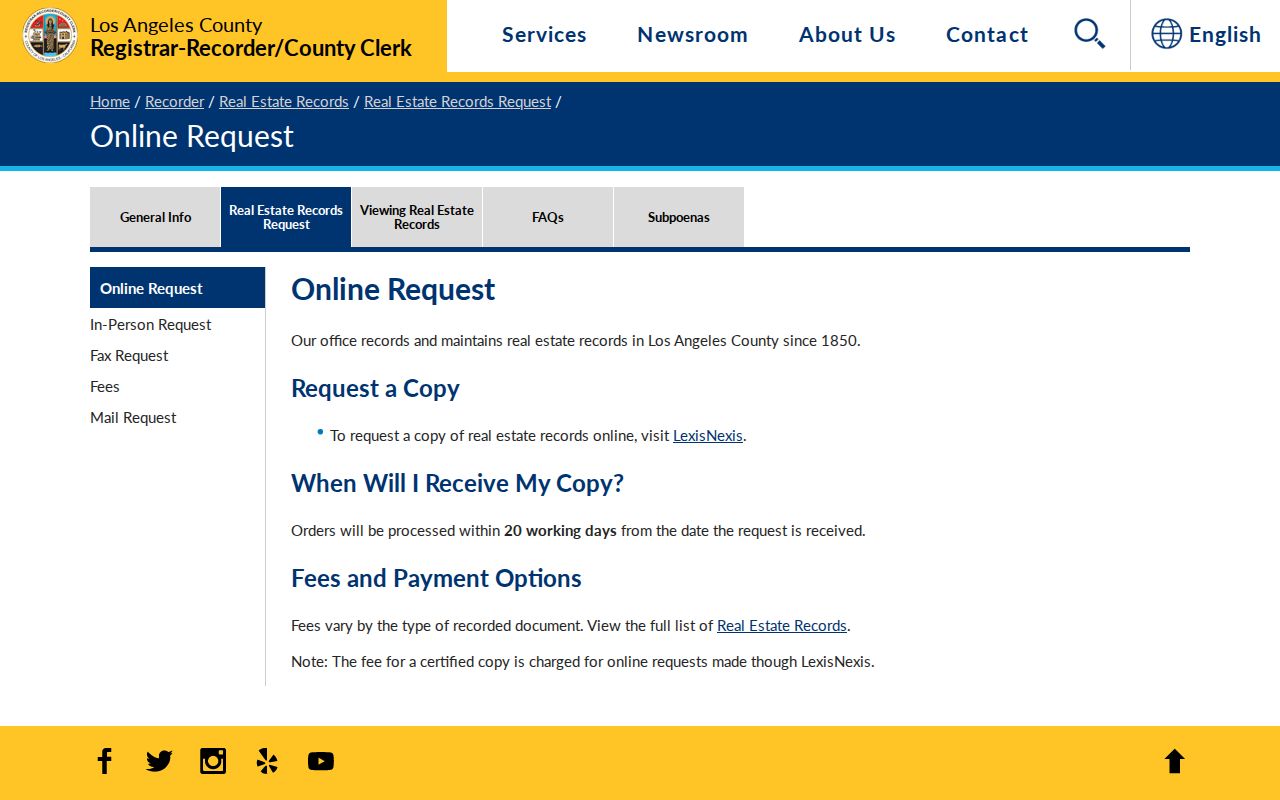
This route works best after the party names and approximate recording date are known. It is not an address-based web index and does not replace the in-person name-and-year search.
Lakewood RRCC Agency Records
Copy orders retrieve a known recorded document. A CPRA request serves a different purpose, such as obtaining RR/CC agency correspondence, policies, or administrative files that are not in a dedicated public database.
For agency records held by RR/CC, the RR/CC Public Records Act Request Center accepts requests and displays prior published requests.
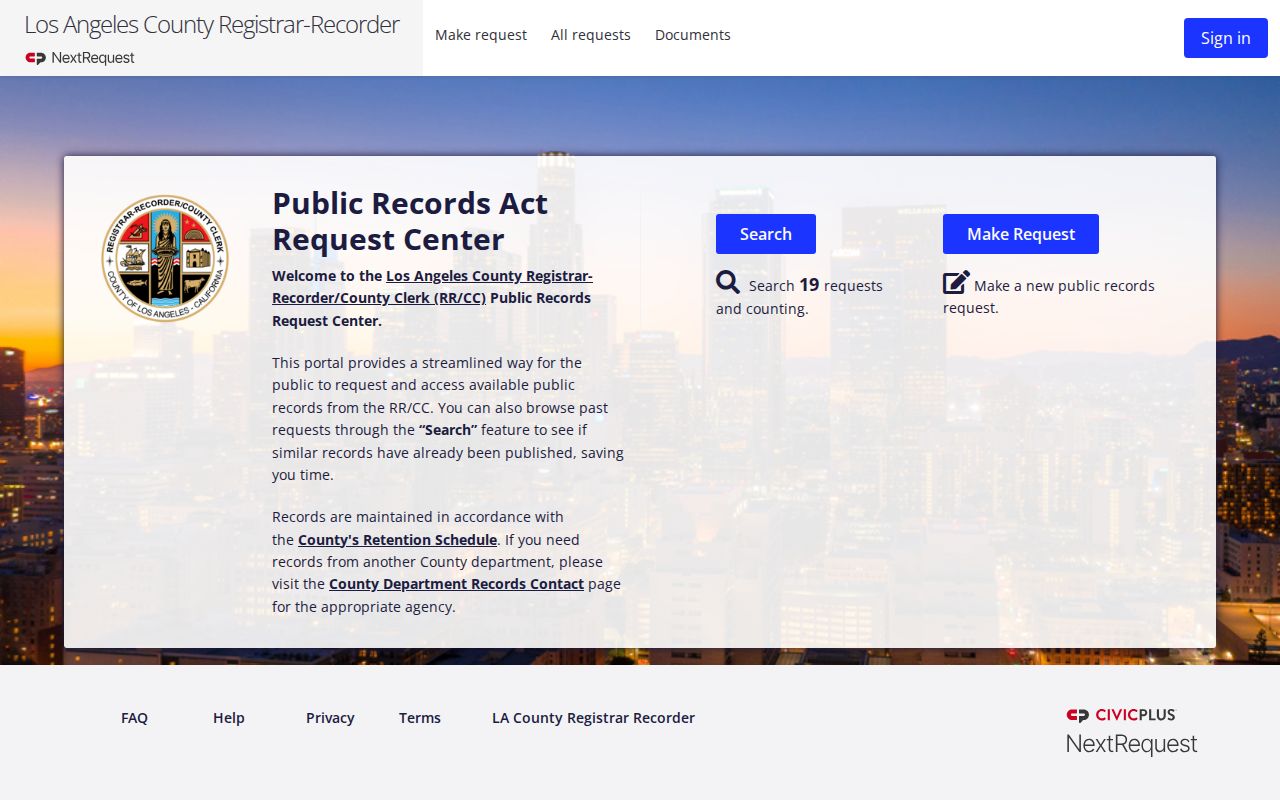
NextRequest is for agency records, not a substitute for deed-index review or a vital-certificate application. Lakewood's older request form cites 25 cents per page for city copies and 10 cents for FPPC filings, though actual charges should be confirmed when the request is submitted.
Lakewood Public Records Boundaries
A custodian is the agency responsible for keeping a record. An exemption is a legal reason to withhold all or part of it. California's CPRA, Government Code section 7920.000 and following, generally favors access, yet it works alongside privacy and safety statutes.
- Index
- A finding aid that identifies a filing without necessarily showing the document.
- Certified copy
- A copy formally authenticated by the office that holds the original record.
- Redaction
- The removal of protected content while the remaining public portion is released.
- Exemption
- A statute-based limit on disclosure, not a claim that every related record is secret.
Safe at Home substitute addresses, protected voter details, DMV personal data, victim and witness information, juvenile files, adoption records, confidential marriages, and sealed cases illustrate those limits. The official voter self-check and restricted voter file deserve their own treatment on the Lakewood voter registration page.
Use records lawfully. Public access does not permit stalking, harassment, intimidation, identity theft, or evasion of a protected-address program. Stop if a search could place someone at risk.
Request Lakewood Public Records
The CPRA requires an agency to determine within 10 days whether responsive records are disclosable. Government Code section 7922.535 permits a 14-day extension for unusual circumstances. This is a decision deadline, not a promise that every document will be produced within ten days. Production may take a reasonable period for collection, review, and lawful redaction.
- Name the right custodian. Use the City Clerk for city business, RR/CC for county recorder or elections agency material, and the court's own process for case or administrative files.
- Check the dedicated access path. A parcel portal, paid court index, vital-record form, inmate locator, or recorder counter may answer the request more directly.
- Describe identifiable records. Give a date range, subject, address, department, names, and known document type. Ask for electronic delivery when suitable.
- Choose inspection or copies. Inspection can avoid copy costs. Ask for an estimate before approving a large duplication charge.
- Refine a denial or delay. Ask for the cited exemption, segregable public portions, and a practical production schedule. Narrow an overly broad request when that will reach the needed file.
Appeal routes vary by agency. A clear written response creates the record needed to seek internal review or legal help. Keep the request focused on documents that already exist, since the Act does not require an office to create a new report or answer research questions.